






























By Infora Media
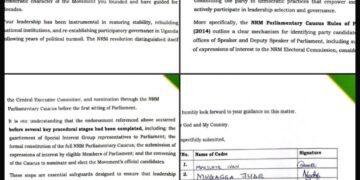
The NRM Revolutionary Network has written to President Yoweri Kaguta Museveni, the National Chairman of the National Resistance Movement (NRM), raising serious concerns over the procedure used to identify the party’s candidates for Speaker and Deputy Speaker of the 12th Parliament.
In a letter dated 8th February 2026, the Network questioned the integrity of the process through which the incumbent Speaker, Anita Annet Among, and Deputy Speaker, Thomas Tayebwa, were endorsed as the official NRM candidates for the respective positions.
The Revolutionary Network highlighted what it termed procedural irregularities, noting that the endorsement appeared to bypass the inclusive and participatory mechanisms that have traditionally governed NRM internal nominations.
“The manner in which our candidates were identified raises questions about fairness and adherence to the NRM’s own democratic standards,” the Network said in the letter. It emphasized that such positions are constitutional, and the party has a responsibility to ensure transparent and credible internal selection processes.
According to sources within the party, the endorsement was made through a communication from the Central Executive Committee (CEC), which did not formally invite other eligible NRM Members of Parliament to express interest in the roles.
The endorsement has sparked debate both within and outside the party. Some NRM MPs have reportedly considered legal recourse, arguing that the process may contravene the NRM Constitution and the broader constitutional provisions governing parliamentary elections.
Political analysts note that while the Speaker and Deputy Speaker are ultimately elected by MPs in a secret ballot, the party’s choice of official candidates significantly influences the outcome, especially for the ruling party with a parliamentary majority.
One source familiar with the matter said, “Even though the positions are elected in Parliament, the NRM’s flagbearer endorsements often determine the final result. That is why the process of selection must be fair and transparent.”
The Revolutionary Network’s intervention underscores the need for inclusive party consultations. Observers say that ensuring broader participation in selecting candidates for constitutional positions is critical to maintaining party cohesion and public confidence.
Party insiders suggest that ignoring these concerns could fuel intra-party dissent and potentially affect the party’s unity as Parliament convenes. “It is important that every eligible member feels the process is open and fair. Otherwise, the party risks alienating capable leaders who could contribute positively to Parliament,” said a senior NRM official who requested anonymity.
As the 12th Parliament prepares to convene, attention will be focused on how the NRM addresses these concerns. Observers expect discussions within the parliamentary caucus and possibly further communications from the party leadership to clarify the selection procedures.
Meanwhile, incumbent leaders Among and Tayebwa have expressed confidence in their continued leadership, citing their tenure as a period of stability and effective parliamentary oversight. However, the Revolutionary Network and other party members emphasize that procedural fairness and internal democracy must guide the process to ensure legitimacy and trust.
The coming weeks are expected to be decisive, not just for the leadership of Parliament, but for the internal democratic credibility of the NRM as it navigates its parliamentary majority and governance responsibilities.