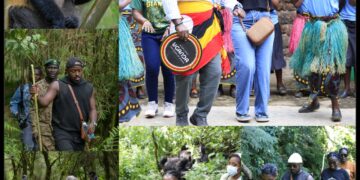











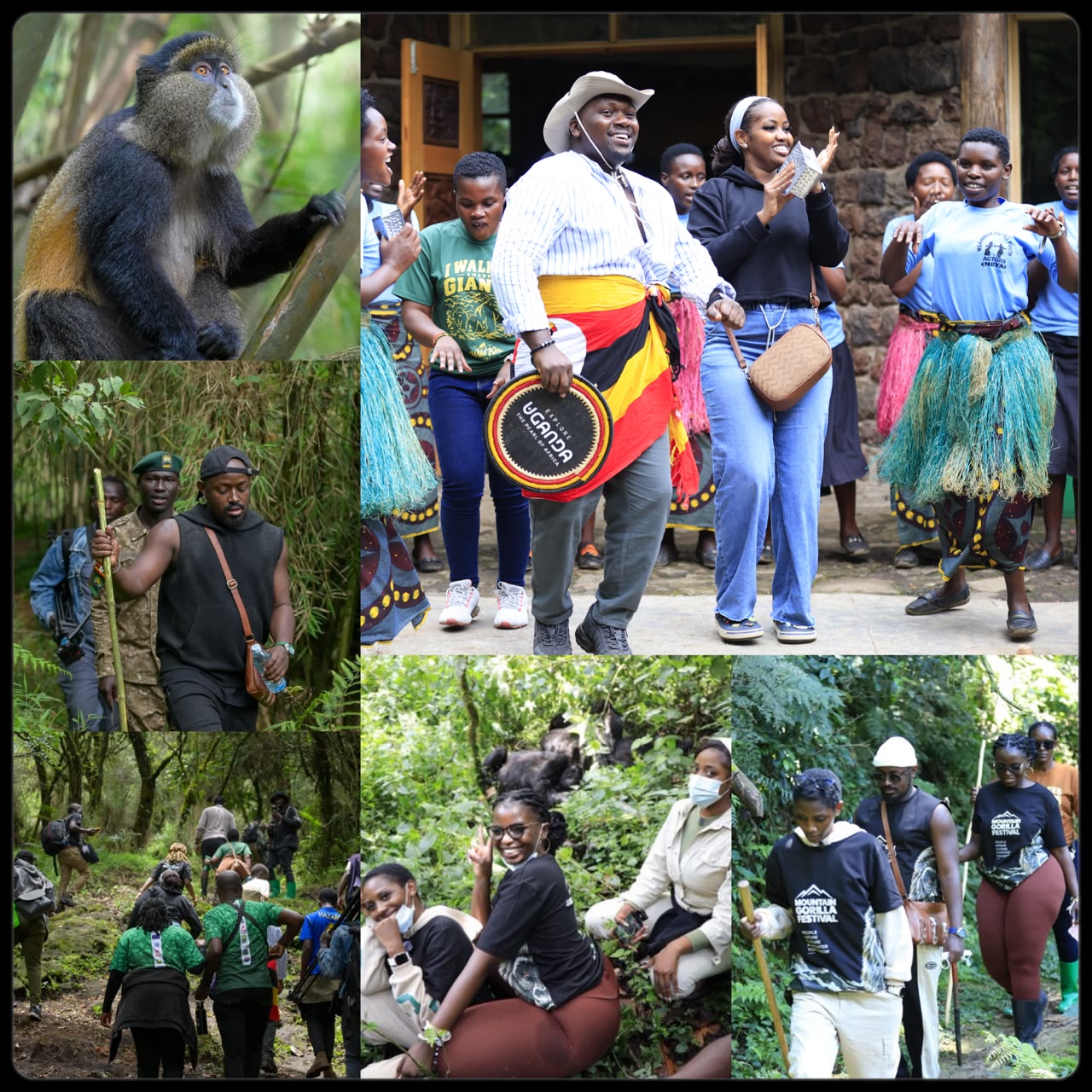
KISORO — The Uganda Wildlife Authority (UWA) has taken a group of influencers and tour operators on gorilla and golden monkey trekking experiences in south-western Uganda as part of efforts to promote the region’s tourism attractions and the upcoming Mountain Gorilla Festival and Gorilla Marathon.
The Mountain Gorilla Festival and Gorilla Marathon are scheduled for November 20 to 22 in Kisoro District.
The team first trekked mountain gorillas in the Rushaga sector of Bwindi Impenetrable National Park before travelling to Mgahinga Gorilla National Park for a golden monkey trekking experience.
Mr Niyongabo Laban, a tour guide and tour operator who was part of the team, said the visit was organised at the invitation of UWA to allow the participants to experience some of the tourism activities offered in the region.
“We are here with a team of influencers on the invitation of the Uganda Wildlife Authority to popularise the Virunga Gorilla Marathon and also the Gorilla Festival,” Mr Niyongabo said.
He said the tourism sector could also benefit from Uganda’s hosting of the Africa Cup of Nations (Afcon) next year, arguing that international visitors attending the tournament could take advantage of their stay to explore the country’s tourism attractions.
“Uganda is hosting Afcon next year. It’s a very great opportunity for us to get more people to come and travel as some of them will definitely come to see the gorillas,” he said.
Before the group embarked on the golden monkey trek, Mr Ochola Juventus, the tourism warden at Mgahinga, briefed the visitors at the park headquarters in Ntebeko.
He said golden monkeys remain one of the attractions that distinguish Mgahinga from many other tourism destinations in the country.
“Golden monkeys in Uganda are only found here in Mgahinga Gorilla National Park,” Mr Ochola said.
He said outside Uganda, the species can be found in Rwanda’s Volcanoes National Park and Gishwati-Mukura National Park, as well as Virunga National Park in the Democratic Republic of Congo.
Mr Ochola explained that golden monkey trekking involves several teams working together to locate and guide visitors to the habituated troop.
Advance trackers move ahead of the visitors and use phones to communicate with the trekking team and guide them through suitable routes.
Armed rangers also accompany visitors to provide security, particularly because the forest is home to potentially dangerous wildlife, including elephants and buffaloes.
Mr Ochola said rangers are trained to respond to encounters with wildlife and may fire warning shots into the air when necessary to deter aggressive animals and allow visitors to continue safely.
For some of the influencers, the trek provided an opportunity to experience attractions they had previously only seen through photographs and videos.
Ms Hellen Namitala, a content creator popularly known as Lenz, said the visit had changed her perception of Uganda’s tourism potential.
“I didn’t know that Uganda had all this beauty because I’ve been just seeing it from afar, but now I’m experiencing it,” she said.
Ms Namitala, who was taking part in golden monkey trekking for the first time, said Uganda’s culture and tourism attractions were among the things she admired most about the country.
She also encouraged Ugandans, particularly those who have never travelled, to explore destinations within the country.
“If you have never travelled like me, guys, start travelling. It is very enjoyable, it is very nice. Come and explore Uganda,” she said.
During the briefing, visitors were reminded of the importance of responsible tourism while in the forest.
They were instructed to carry all waste, including water bottles and food wrappers, out of the park and to keep their voices low to avoid disturbing wildlife.
Visitors who need to relieve themselves are required to inform the lead guide, who identifies an appropriate location. Solid human waste must be buried in a hole about 30 centimetres deep and properly covered afterwards.
The guidelines are intended to minimise human impact on the fragile forest ecosystem.
Mgahinga Gorilla National Park was gazetted in 1991 and opened to tourists in 1993. Covering about 33.7 square kilometres, it is Uganda’s smallest national park but contains a diverse range of wildlife, forests and volcanic landscapes.
The park is part of the larger Virunga landscape and is home to three extinct volcanoes—Muhavura, Gahinga and Sabinyo.
Muhavura is the highest of the three, rising to about 4,127 metres above sea level and featuring a crater lake at the summit. Gahinga rises to about 3,474 metres and has a swamp at its summit, while Sabinyo forms part of the border area where Uganda, Rwanda and the Democratic Republic of Congo meet.
The park also has about 180 bird species, including 17 Albertine Rift endemics.
Gorilla trekking remains one of the park’s major tourism activities. According to Mr Ochola, the park currently has one habituated gorilla group comprising 11 members, including three silverbacks.
Visitors can also experience the cultural heritage of the Batwa community through guided trails that demonstrate aspects of their former forest life.
Batwa guides demonstrate traditional practices such as trapping, traditional medicine and making fire by rubbing two sticks together.
The cultural trail ends at Garama Cave, which is traditionally associated with the Batwa king.
Through the influencer and tour operator visit, UWA hopes to increase awareness of the tourism experiences available in south-western Uganda while drawing attention to the upcoming Mountain Gorilla Festival and Gorilla Marathon in Kisoro.