












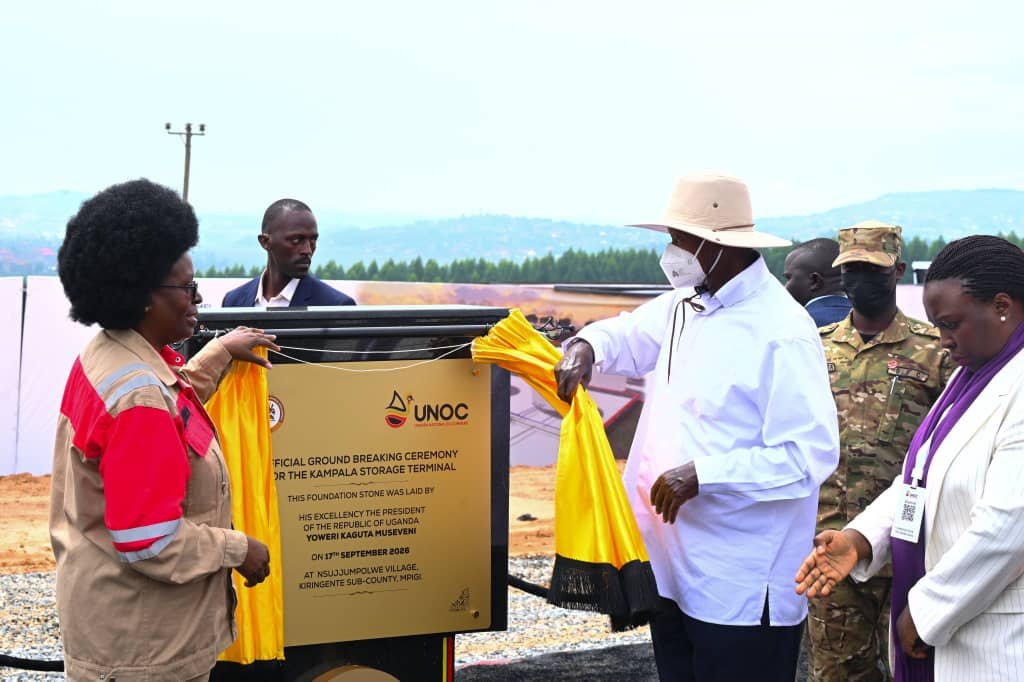
MPIGI — President Yoweri Museveni has broken ground for the Shs1.15 trillion Kampala Storage Terminal (KST) in Namwabula, Mpigi District, as Uganda moves to expand its petroleum storage capacity and strengthen fuel supply security.
The $310 million facility, being developed by the Uganda National Oil Company (UNOC), will have capacity to store up to 320 million litres of refined petroleum products.
The terminal is expected to provide strategic reserves that can help Uganda manage disruptions along import routes, international supply constraints and other shocks that could affect fuel availability.
Uganda consumes about 240 million litres of petroleum products each month, including petrol, diesel, jet fuel and kerosene.
Speaking at the groundbreaking ceremony, President Museveni questioned whether the planned storage capacity would be sufficient as petroleum demand rises with economic growth.
“We are now moving slowly out of sleep,” Mr Museveni said, reflecting on Uganda’s previous dependence on imported petroleum products and its limited storage infrastructure.
He noted that the existing Jinja Storage Terminal has a capacity of about 30 million litres, compared with national monthly consumption of approximately 240 million litres.
“This one here will be 320 million litres, which should secure us for a month plus,” he said, while calling for continued expansion of storage infrastructure as demand increases.
The KST will complement the Jinja Storage Terminal and facilities operated by private oil companies. Government is also upgrading the Jinja facility from 30 million litres to about 40 million litres.
Once the two government-managed facilities are completed, their combined capacity will be about 360 million litres.
UNOC Board chairman Mathias Katamba said the KST would increase the country’s ability to maintain adequate petroleum reserves and respond to disruptions along import corridors and fluctuations in global supply.
He said the facility would accommodate government strategic reserves, provide storage and handling services to oil marketing companies and support the distribution of petroleum products across the country.
The terminal is being developed on about 300 acres at Namwabula Estate and is expected to serve Kampala, the Central Region and other parts of Uganda.
It is also intended to support Uganda’s ambition of becoming a regional petroleum distribution hub.
The project will be linked to other planned petroleum infrastructure, including the country’s proposed refinery and petroleum products pipeline network.
It is expected to connect to the planned Uganda Refinery through a proposed 211-kilometre multi-products pipeline from Hoima to Buloba. The terminal will also incorporate the future Mpigi Remote Refinery Terminal, which is expected to receive, store and dispatch locally refined petroleum products.
Once the refinery, pipeline, Mpigi terminal and KST are operational, the government expects Uganda to have an integrated system for receiving, storing and distributing both imported and domestically refined petroleum products.
Energy and Mineral Development Minister Monica Musenero described the terminal as an important investment in Uganda’s energy security.
“The project goes beyond increasing storage capacity. It provides Uganda with the infrastructure required to maintain strategic petroleum stocks and respond to potential supply disruptions and international market shocks,” she said.
Ms Musenero said government was also planning three regional petroleum products storage facilities to bring strategic reserves closer to consumers in different parts of the country.
The government is also exploring additional petroleum supply routes through Lake Victoria as part of efforts to diversify imports.
However, she said the KST would require supporting infrastructure, including a dedicated road connection to the Mpigi Expressway, a planned 33KV electricity line, reliable ICT connectivity, water supply and railway connectivity.
The facility is expected to handle about 450 fuel trucks a day when fully operational, with the project anticipated to generate direct and indirect employment in Mpigi and surrounding areas.
Ms Musenero also called for proper land-use planning around the facility, particularly because of the proximity of a planned waste disposal site.
The KST is part of government’s plans under the Fourth National Development Plan (NDP IV) to increase national storage capacity for refined petroleum products.
The plan targets an increase in national storage capacity from 99.1 million litres in the 2023/24 financial year to 150 million litres by 2029/30. It also provides for the expansion of the Jinja Storage Terminal and development of regional strategic petroleum storage facilities.
Mr Katamba said Ugandan companies would have opportunities to participate in construction, logistics, maintenance and other services associated with the project.
The project comes as Uganda advances preparations for commercial oil production and the development of an integrated petroleum industry.
President Museveni recently named Uganda’s crude oil “Pearl Sweet”, as the country prepares for commercial production from the Tilenga and Kingfisher projects.
Peak crude oil production is projected at about 230,000 barrels per day. Crude oil will be transported through the East African Crude Oil Pipeline to the Port of Tanga in Tanzania for export, while government develops infrastructure for domestic refining and petroleum products distribution.
The KST is expected to form part of the downstream infrastructure connecting imported and locally refined petroleum products to storage and distribution networks serving Uganda and regional markets.