
















KAMPALA — Long before he became one of East Africa’s most successful entrepreneurs, businessman Sudhir Ruparelia arrived in the United Kingdom as a teenage refugee with little certainty about what the future held.
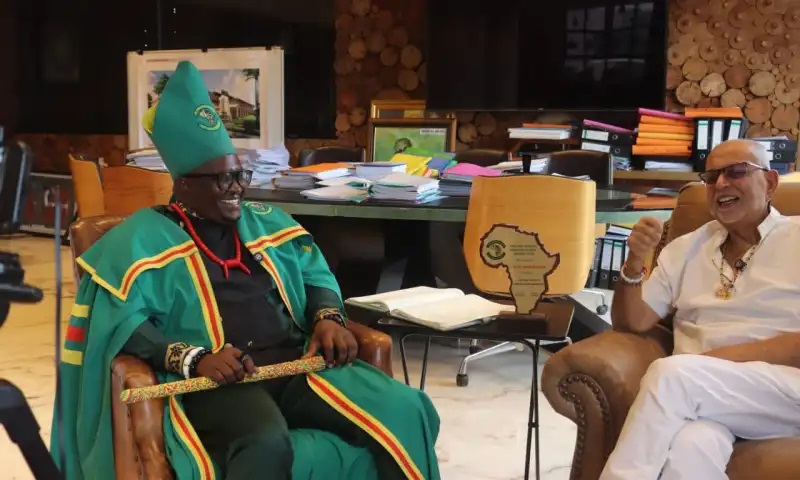
Speaking during an interview at Crane Chambers with Pan African Pyramid (PAP) founder Andrew Irumba Katusabe, the Ruparelia Group chairman reflected on the journey that took him from life in a refugee reception camp in Britain to building one of Uganda’s largest privately owned business empires.
Mr Ruparelia said he arrived in England on November 6, 1972, following the expulsion of Asians from Uganda. Upon arrival, he was received at a government refugee resettlement centre before travelling to London the following day to stay with relatives.
The early years, he recalled, were marked by hardship and uncertainty.
He lived in a modest two-bedroom house occupied by seven people, a situation he said reflected the struggles many Ugandan Asian families faced as they rebuilt their lives in Britain.
After reuniting with his parents, Mr Ruparelia searched for employment in several British towns, including Birmingham, Manchester and Stockport, taking on any opportunity that could provide income and stability.
One of his earliest experiences involved travelling with an uncle in search of work at the Ford Motor Company. The pair spent an entire night sleeping on cardboard outside the home of a man who had promised to assist them after finding he was away when they arrived.
Although the promised opportunity did not materialise because of company hiring policies and his age, Mr Ruparelia remained determined.
He later secured factory work performing physically demanding tasks before moving to London, where he combined employment with further education.
To support himself, he worked nights in supermarkets stocking shelves, cleaning and assisting in bakery operations while attending classes during the day.
On weekends, he supplemented his earnings by driving a taxi, often working continuously from Friday evening until Sunday night.
The demanding routine enabled him to save aggressively.
By 1976, at the age of 20, Mr Ruparelia had accumulated enough savings to purchase his first house in Britain. The property, bought for £15,250 with a substantial deposit and mortgage financing, became the foundation of what would later grow into a successful property investment portfolio.
It was also during this period that he met the woman who would become his wife.
According to Mr Ruparelia, they first crossed paths aboard a London bus while travelling to attend a wedding. A chance encounter later led him to take weekend work at the same supermarket where she was employed as a cashier while pursuing her studies.
Although her family initially preferred she marry someone in a more traditional profession, the couple remained committed to each other and married in London in 1977.
Mr Ruparelia credited his wife with providing unwavering support during the early years of building their financial future through property investment and hard work.
The couple would later raise three children — Meera, Sheena and the late Rajiv Ruparelia.
Despite establishing a stable life in Britain, Mr Ruparelia said he felt a strong desire to return home.
“Africa is either in your blood or it is not in your blood,” he said.
Encouraged by relatives who spoke of improving opportunities in Uganda, he travelled to Nairobi before returning to Uganda in early 1985, initially leaving his wife in Britain as he explored business prospects.
He began with the trading of salt before gradually expanding into other sectors, laying the foundation for what would become the diversified Ruparelia Group, with interests spanning real estate, hospitality, education, finance and agriculture.
Mr Ruparelia said purchasing his first home in Uganda in 1991 marked another important milestone, symbolising his long-term commitment to rebuilding his life and investing in the country he still considered home.
His story, he said, demonstrates how resilience, discipline and long-term planning can transform adversity into opportunity, turning the experience of displacement into one of Uganda’s most remarkable business success stories.