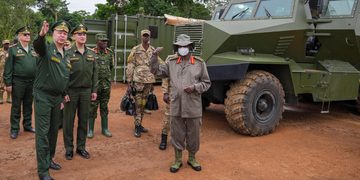





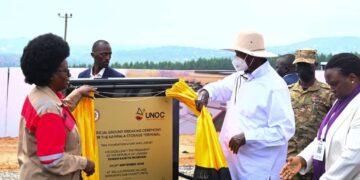


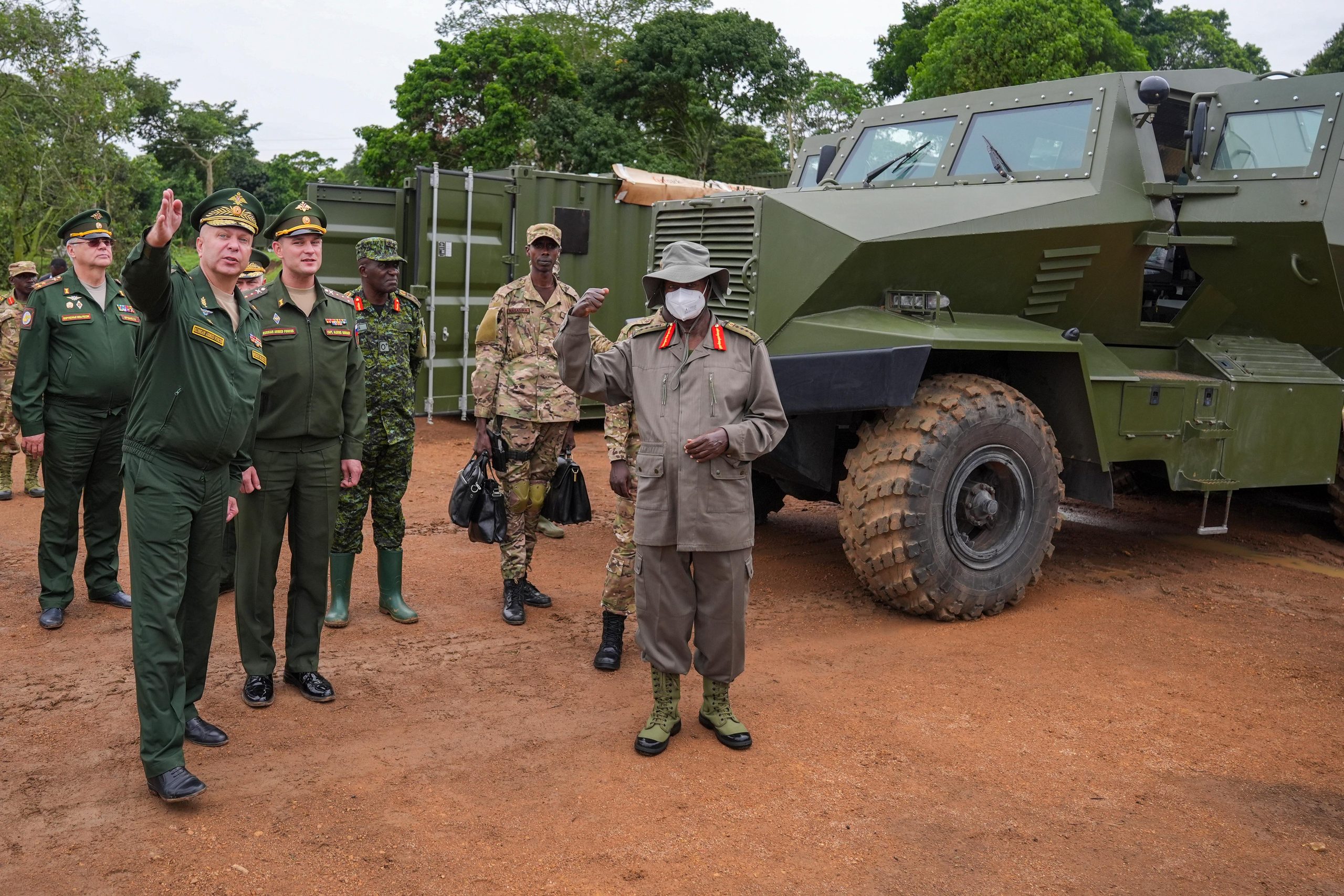
President Yoweri Kaguta Museveni has commissioned a $53 million mechanised military repair facility in Jinja District as Uganda deepens defence cooperation with Russia to modernise the armed forces, strengthen marine security and improve military equipment maintenance.
The commissioning formed part of a two-day programme on October 21 and 22, during which Mr Museveni visited military training, marine security and technical installations developed with Russian support.
The President, who is also the Commander-in-Chief of the UPDF, was accompanied by a Russian delegation led by Lieutenant General Aleksandr Kshimovskii.
At Magamaga, Mr Museveni thanked Russian President Vladimir Putin and the delegation for the equipment, saying the support would strengthen Uganda’s ability to maintain and repair military machinery.
“First of all, I really want to thank His Excellency President Putin and the Russian delegation for this gift of $53 million worth of equipment,” he said.
He, however, emphasised that Uganda’s military modernisation should go beyond acquiring foreign equipment to developing local technical expertise and manufacturing capacity.
“But these materials, I think, were made in Russia. What if we made them here with the Russians?” he asked.
The President’s remarks pointed to the potential for technology transfer and joint production, which could help Uganda reduce reliance on foreign maintenance services while developing domestic defence industry skills.
The programme began on Wednesday, October 21, at the Mechanised Warfare College in Kalama, Mubende District, where Mr Museveni launched a digital multimedia training classroom designed to prepare military crews to operate the BRDM-2MS armoured reconnaissance vehicle.
The facility will enable personnel to study the vehicle’s operating systems and capabilities before undertaking practical training.
The President later proceeded to the 15 Marine Brigade Pier in Entebbe, where he commissioned marine operational assets and supporting infrastructure intended to strengthen the UPDF’s capacity to monitor and secure Uganda’s waters.
The installations included surveillance radar, eight boats, a floating dock, protective barriers, marine workshops, firefighting equipment, specialised vehicles, a field ambulance and training facilities.
The assets are expected to improve maritime surveillance, operational readiness and the military’s ability to respond to security threats on the country’s waters.
On Thursday, October 22, Mr Museveni visited the 154 Marine Battalion School at Kalangalo, where he called on the military to embrace emerging technologies, including artificial intelligence (AI) and automation.
“Advance on the issue of technology, embrace new technology, more automation, more AI, more range because we need to upgrade it overall,” he said.
He stressed that the acquisition of sophisticated equipment must be accompanied by investment in the skills required to operate, service and maintain it.
The President’s message underscored the importance of preparing military personnel for emerging security challenges through continuous training and technological advancement.
The Minister of Defence and Veteran Affairs, Kiryowa Kiwanuka, commended Mr Museveni for strengthening relations with Russia and thanked Russian technical experts for supporting the development and equipping of the military installations.
He said the President’s engagement with the Russian leadership had sustained diplomatic relations and opened opportunities for cooperation, particularly in defence and military technical assistance.
“Your continued engagement with the Russian leadership has sustained the cordial diplomatic relations between our two countries and opened avenues for mutually beneficial cooperation, particularly in defence and military technical assistance. We thank you most sincerely,” Mr Kiwanuka said.
He added that the Russian government’s contribution had supported several defence installations across the country.
The Ministry of Defence and Veteran Affairs and the UPDF leadership pledged to ensure the facilities were properly utilised and maintained to achieve their intended objectives.
Lieutenant General Kshimovskii reaffirmed Russia’s commitment to continued military technical cooperation with Uganda, saying Moscow was prepared to provide equipment to support the country’s defence capabilities.
“We shall continue to develop mutual cooperation between Uganda and Russia. Russia is ready to supply the necessary equipment,” he said.
The programme brought together UPDF brigade commanders, junior officers, representatives of sister security agencies and local leaders.
The commissioning of the facilities highlights Uganda’s continued investment in military modernisation, with emphasis on equipment maintenance, maritime security, technical training and the adoption of advanced technologies.
The proposed collaboration on local production could also open opportunities for skills development and technology transfer, although the details of any joint manufacturing arrangements were not outlined during the commissioning activities.