














KAMPALA — Steel manufacturer Roofings Group generated Shs400.1 billion in total value addition to Uganda’s economy in 2025, underscoring the contribution of local manufacturing to exports, employment and government revenue.
The company’s 2025 economic performance figures show that its activities extended beyond steel production, with the manufacturer supporting local industries, earning foreign exchange through exports and contributing to the national tax base.
Roofings recorded gross export sales of Shs229.6 billion during the year.
The company said the figure accounted for 2.1 per cent of Uganda’s goods exports to the East African Community (EAC) and 0.5 per cent of the country’s total goods exports to the global market.
Tax contribution
Roofings paid Shs191.2 billion in taxes during the year, making the company a significant contributor to government revenue.
It also remitted Shs10 billion in National Social Security Fund (NSSF) contributions, further increasing its contribution to the economy.
The manufacturer consumed electricity worth Shs26.8 billion in 2025, highlighting the importance of energy costs to large-scale industrial operations.
Roofings has welcomed recent reductions in industrial electricity tariffs but has called for improvements in the reliability of power supply and transport infrastructure to help lower production and distribution costs.
Supporting local manufacturers
The company supplied raw materials and other industrial inputs to 111 local manufacturers in 2025.
Roofings said the supply of locally produced materials helps businesses access inputs closer to home while reducing reliance on imported products.
Its operations also supported 1,975 jobs, providing incomes for workers and contributing to economic activity in surrounding communities.
The figures come as Uganda continues to promote industrialisation and local value addition as part of efforts to reduce dependence on imported manufactured goods.
Expansion of steel production
Roofings has also been expanding its production capacity.
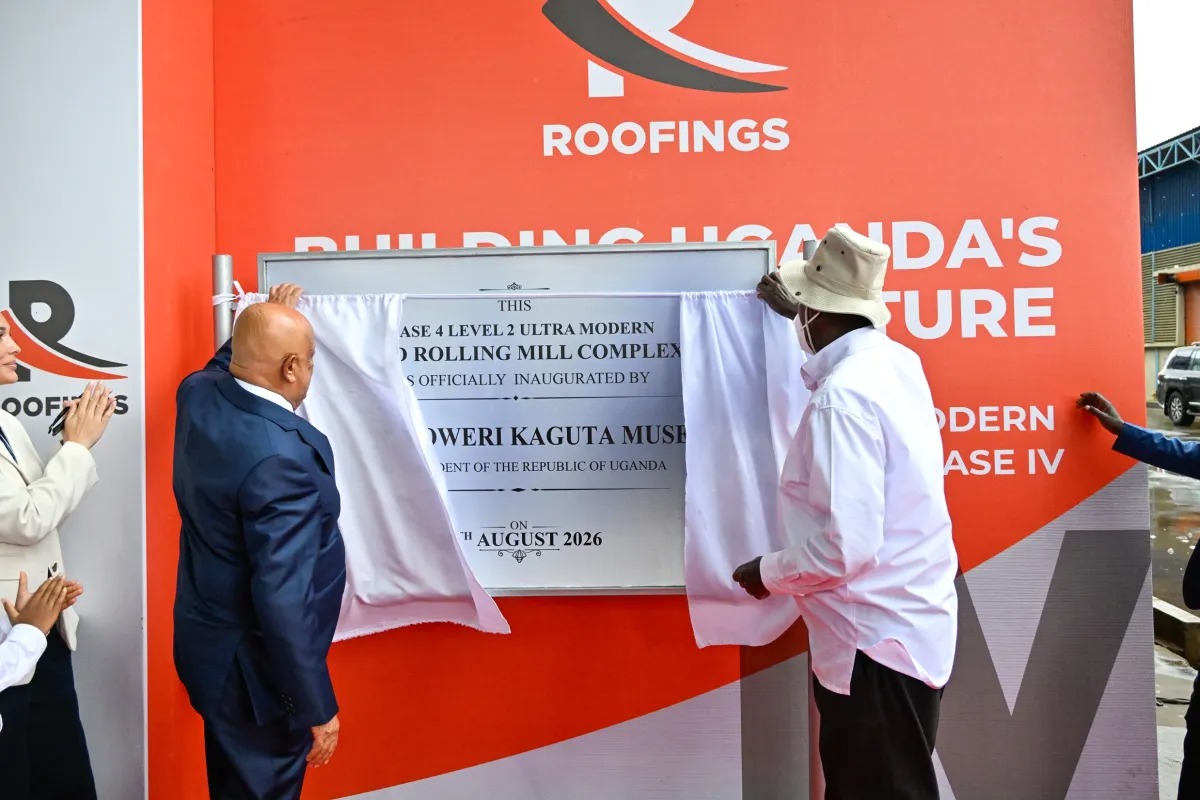
President Yoweri Museveni recently commissioned Phase IV Level 2 of the company’s rolling mill complex at Namanve in Mukono District, a development expected to increase local production of intermediate steel products.
The integrated complex includes a cold rolling mill, edge-trimming line, galvanising line and colour-coating line.
The cold rolling mill is expected to facilitate further processing of steel within Uganda and increase production of higher-value products.
At the commissioning ceremony, President Museveni emphasised the importance of a large and reliable market in supporting industrial investment.
“A strong market makes it easy for wealth creators to succeed,” Mr Museveni said, noting that access to a wider regional market would enable manufacturers to increase production, create jobs and generate wealth.
The President also highlighted Uganda’s iron ore reserves, including deposits with reported purity levels of about 65 per cent, as an opportunity to develop a stronger domestic steel industry and reduce reliance on imported finished products.
Energy and transport challenges
Roofings chairman Sikander Lalani welcomed the reduction in industrial electricity tariffs, saying lower energy costs had provided manufacturers with some relief.
He, however, called for a more reliable electricity supply and improvements in railway infrastructure to reduce transport costs and improve the movement of industrial goods.
Trade, Industry and Cooperatives Minister Sanjay Tanna said Uganda’s industrial electricity tariffs were now among the most competitive in the region, arguing that the reductions had strengthened the country’s investment environment.
Roofings director Oliver Lalani said East Africa’s growing population and middle class offered opportunities for the steel industry.
He said improving the quality and availability of steel products in the regional market would be important as construction activity and demand for building materials increase.
Roofings’ 2025 performance highlights the wider economic role of manufacturing, with the company reporting Shs400.1 billion in value addition, Shs229.6 billion in exports, Shs191.2 billion in taxes, Shs10 billion in NSSF contributions, 111 local manufacturers supplied and 1,975 jobs supported.