
















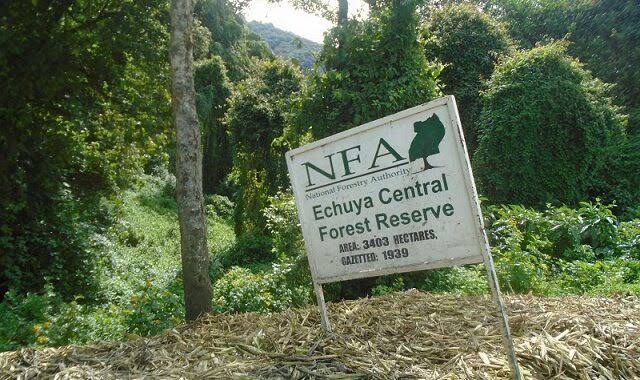
KISORO — The transfer of Echuya Central Forest Reserve to the Uganda Wildlife Authority (UWA) has renewed calls for the government to turn the Kigezi forest into a major conservation and tourism destination.
Local leaders, conservationists and tourism stakeholders say the change in management could provide an opportunity to restore degraded sections of the forest, strengthen protection of its biodiversity and develop new tourism products for the region.
Echuya, which was previously managed by the National Forestry Authority (NFA), is among three central forest reserves whose management has temporarily been placed under UWA.
Minister of Tourism, Wildlife and Antiquities Tom Butime recently gazetted measures transferring the management of Echuya, Bugoma and Bakaleba central forest reserves to UWA.
The measures, issued under Section 28 of the Uganda Wildlife Act, Cap 315, are expected to remain in force for six months as government works towards having Parliament declare the forests wildlife conservation areas.
Former Kisoro District LCV chairman Abel Bizimana, whose district council was among those that advocated for UWA’s involvement in Echuya, said the development could help transform the region’s tourism sector.
Mr Bizimana called for government to consider compensating landowners occupying the corridor between Echuya and Bwindi Impenetrable National Park to facilitate the creation of a larger conservation landscape.
He said linking the two ecosystems could improve wildlife conservation while increasing tourism opportunities and revenues for Kisoro and Rubanda districts.
He also urged government to invest in tourism infrastructure, including a regional cultural centre and a modern tourism information centre in Kisoro town.
According to Mr Bizimana, the local government has already provided land for the proposed tourism information centre.
Wildlife potential
Mr Bizimana also suggested that UWA explore the possibility of developing additional wildlife attractions in Echuya.
He proposed the habituation of at least two mountain gorilla families or chimpanzees, arguing that the forest shares some ecological characteristics with Bwindi.
He also suggested that golden monkeys could be considered as another potential tourism attraction.
Echuya already supports a variety of wildlife and biodiversity, including numerous bird species, butterflies, baboons and monkeys.
However, conservationists say tourism development should go hand in hand with restoration and protection of the forest’s ecological integrity.
The International Gorilla Conservation Programme’s Uganda country coordinator, Mr Henry Mutabaazi, described the transfer of management to UWA as a long-awaited intervention.
He said resolutions by the Kisoro and Rubanda district councils calling for stronger protection of Echuya were partly prompted by concerns over degradation and exploitation of the forest’s resources.
Mr Mutabaazi urged UWA to prioritise restoration, particularly in areas affected by agricultural activities and exotic tree plantations.
“Additionally, I recommend that UWA carries out restoration of degraded portions of the forest that were affected by cultivation of Irish potatoes. Also, complete removal of plantation stands of exotic tree species such as pine should be a priority to restore the integrity of the natural forest,” he said.
He said some parts of Echuya had been affected by livestock grazing, potato cultivation and suspected illegal mining, which he attributed partly to inadequate management presence.
Ecological importance
Mr Mutabaazi said Echuya’s importance extends beyond tourism, noting that the forest is home to several Albertine Rift endemic species.
Among them is the Grauer’s rush warbler, which is found around the Muchuya swamp.
The forest also supports blue monkeys, small mammals and other wildlife.
The Muchuya swamp is an important water catchment area, supplying water to River Kashasha in Kacerere Sub-county and contributing to water sources believed to replenish the Chuho system, one of the historic water sources serving Kisoro town.
Echuya’s bamboo resources are also important to neighbouring communities, which have traditionally relied on the forest for raw materials used in various local activities.
Mr Mutabaazi urged UWA to strengthen the forest’s boundaries, increase conservation awareness among communities and maintain collaborative conservation arrangements involving stakeholders such as NFA and Nature Uganda.
He also called for a comprehensive assessment of the forest’s biodiversity and natural resources to establish opportunities for sustainable tourism development.
Tourism investment
The proposed changes have also attracted interest from tourism stakeholders in the region.
Kigezi Tourism Cluster chairman Canon Ivan Mbabazi Batuma, together with honorary wildlife officer Fidel Kanyamunyu, encouraged private investors to explore opportunities around Echuya as government considers its long-term conservation status.
Mr Batuma said placing Echuya under UWA could strengthen the Kigezi tourism circuit by adding another attraction to a region already known for Bwindi and other natural and cultural tourism sites.
“As the Kigezi tourism cluster, we welcome the putting of Echuya under the management of UWA because it boosts tourism in our area,” he said.
Stakeholders, however, want government to use the six-month temporary management period to develop a clear long-term strategy for the forest.
They say the strategy should balance conservation, community interests and responsible private investment.
If properly managed, stakeholders argue, Echuya could become an important tourism destination, generating income for surrounding communities while contributing to the protection of one of Kigezi’s important natural ecosystems.