











KAMPALA — Businessman Sudhir Ruparelia has shared rare memories of his childhood in western Uganda, recounting life alongside wildlife in Kasese District and the emotional circumstances that forced him to leave the country during the 1972 expulsion of Asians.
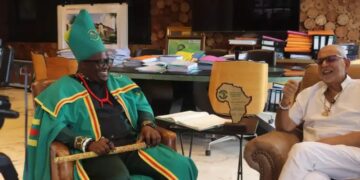
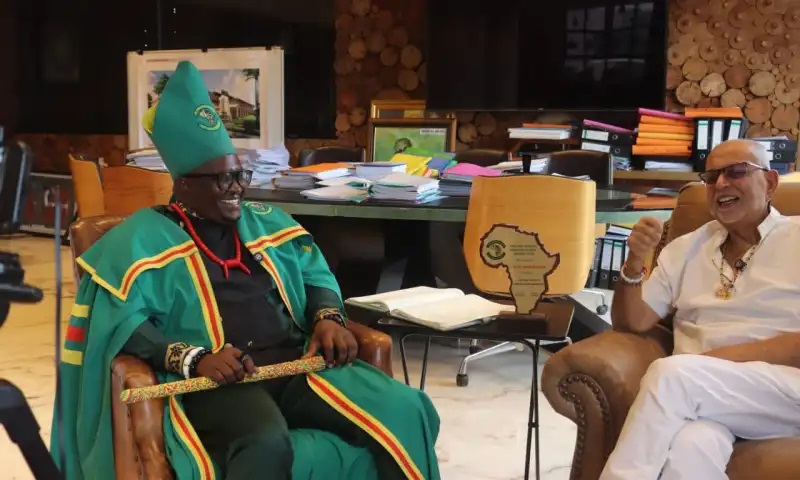
Speaking during an interview at Crane Chambers with Pan African Pyramid (PAP) founder Andrew Irumba Katusabe, the Ruparelia Group chairman reflected on his family’s long history in Uganda, describing himself as a fourth-generation Ugandan whose roots in East Africa date back more than a century.
According to Mr Ruparelia, his great-grandfather first arrived in Mombasa in 1897 before the family later settled in Uganda. His father was born in Kampala in 1932, while he was born at Nakasero Hospital in 1956.
“We are four generations in Uganda,” he said, adding that his children were also born in the country.
Mr Ruparelia said he spent much of his early childhood in Katwe-Kabatoro, near Queen Elizabeth National Park in Kasese District, where encounters with wild animals were part of everyday life.
He recalled that elephants, buffaloes, hippos and antelopes frequently wandered close to homes, while lions were a common sight in the surrounding area.
Among his most vivid memories was an incident involving elephants that regularly visited the family home at night in search of food scraps.
He said that on one occasion, when his mother was away and no cooking had taken place, the animals found no food in the rubbish bin and damaged part of the family’s house.
Another childhood experience, he said, has remained unforgettable.
“My dad took us to see lions, then the car refused to start in front of over 20 lions,” Mr Ruparelia recalled.
The family had driven into the national park in their Volkswagen to view wildlife when the vehicle stalled near a pride of lions.
He said panic set in as they repeatedly tried to restart the engine while surrounded by the animals before the car eventually started, allowing them to drive away safely.
Despite living close to wildlife, Mr Ruparelia described his upbringing as modest.
His family operated a retail shop and petrol station in Kabatoro and placed a strong emphasis on education.
At the age of five, he joined boarding school in Kampala before continuing his studies in Jinja and later returning to Kampala for secondary education.
His education, however, was interrupted in 1972 when President Idi Amin ordered the expulsion of Asians from Uganda.
Mr Ruparelia said he remained in the country until the final day of the 90-day deadline because he considered Uganda the only home he had ever known.
“I wanted to stay,” he said.
Holding a Ugandan passport at the time, he said leaving the country was one of the most difficult decisions he had ever faced.
Eventually, with conditions deteriorating and many towns becoming deserted, he departed Uganda on November 5, 1972, at the age of 16.
Mr Ruparelia said he arranged his own journey after his parents left him with enough money to purchase an airline ticket.
He revealed that he used part of the money to help other families who could not afford to leave Uganda, buying air tickets for some of them, including one family of five.
He said helping others reflected the values instilled in him from an early age, emphasising the importance of supporting those in need.
Mr Ruparelia’s departure marked the beginning of a new chapter that would see him rebuild his life in the United Kingdom before returning to Uganda in 1985 to establish what would grow into the Ruparelia Group, one of East Africa’s largest privately owned business conglomerates.
Looking back, he said the experiences of his childhood, displacement and eventual return to Uganda shaped the resilience and determination that have defined both his personal journey and business career.