















KAMPALA. Victoria University Vice Chancellor Prof Lawrence Muganga has urged the government to introduce a nationwide laptop programme for learners, saying access to digital tools will be critical to preparing Uganda’s workforce for an economy increasingly shaped by artificial intelligence (AI).
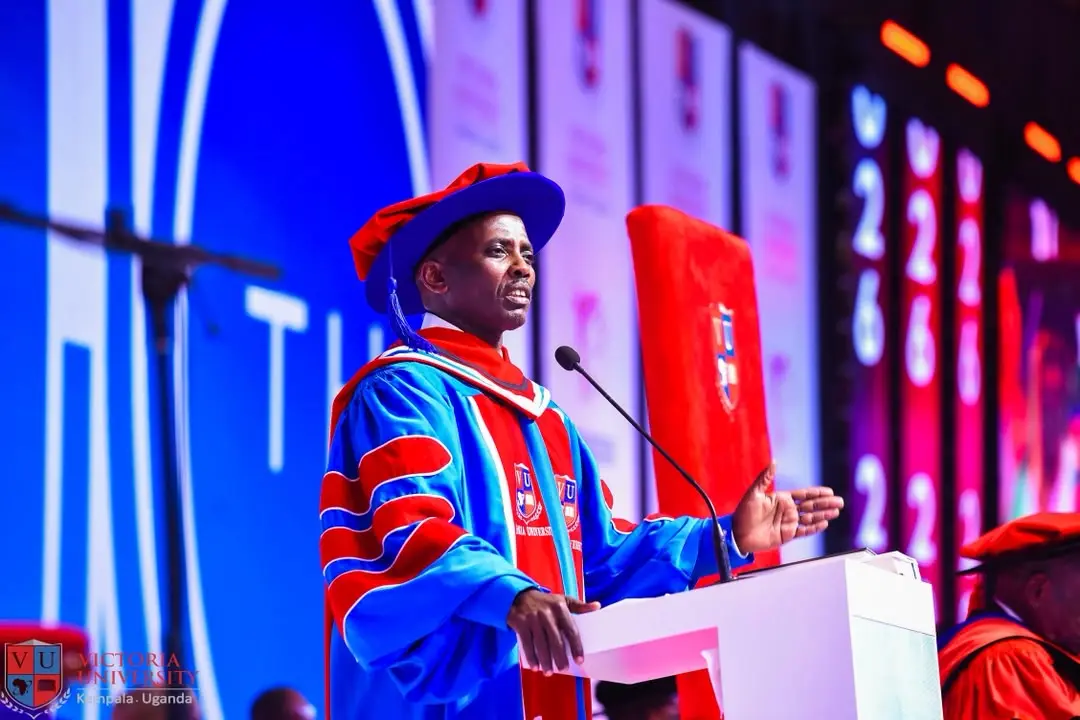
Speaking at the university’s 10th graduation ceremony at Speke Resort Munyonyo on Monday, October 19, 2026, Prof Muganga proposed providing laptops to learners from Primary Five through university, including those enrolled in technical and vocational education and training institutions.
He argued that without deliberate investment in digital access and skills, Uganda risks missing opportunities created by rapid technological change.
“Uganda is our ship. Africa is our ship. It has struck an iceberg. And the iceberg has a name. Artificial Intelligence,” Prof Muganga said, drawing parallels between the AI revolution and earlier industrial transformations.
He called on government, parents, universities and employers to prepare young people for emerging technologies, linking digital readiness to Uganda’s ambition of expanding its economy tenfold by 2040.
“There is only one way to grow 10 times. Every Ugandan must become 10 times more productive,” he said.
Prof Muganga proposed solar-powered laptops for learners in areas with unreliable electricity and satellite internet connectivity to improve access in underserved communities.
He said the proposed interventions should translate the country’s digital ambitions into practical measures that enable learners to acquire relevant skills.
Graduate employment
The vice chancellor also used the graduation ceremony to highlight the university’s reported graduate employment outcomes and its efforts to align academic programmes with labour market demands.
According to figures presented by Prof Muganga, 89 per cent of the graduating students were leaving the institution with jobs or placements, compared with 87.2 per cent in the previous year.
He further disclosed that 53 per cent of the graduating class had pursued science-related disciplines, which he said reflected the institution’s focus on producing professionals with technical and scientific skills.
However, Prof Muganga emphasised that graduates in the arts and humanities also remained important to national development, arguing that economic transformation requires complementary skills across disciplines.
He said the university was incorporating artificial intelligence into its teaching and learning programmes, including courses in law, business, nursing and hospitality.
The vice chancellor challenged universities to move beyond an examination-centred approach to education and prioritise practical competencies that prepare students for employment and other real-world demands.
“Not ready to pass. Ready to live,” he said, describing the need for graduates to leave university equipped to navigate changing workplace expectations.
New campus planned
Prof Muganga also announced plans to begin construction of a new Victoria University campus in Naguru, Kampala, in January 2027.
The proposed development is expected to include modern learning facilities and a teaching hospital to support the institution’s planned medical school.
He said the expansion would help accommodate the university’s growing student population while strengthening its capacity to deliver technology-oriented education.
The graduation marked ten years of the university’s operations and brought together graduates, university officials, parents and other stakeholders to reflect on its progress and the future of higher education.