










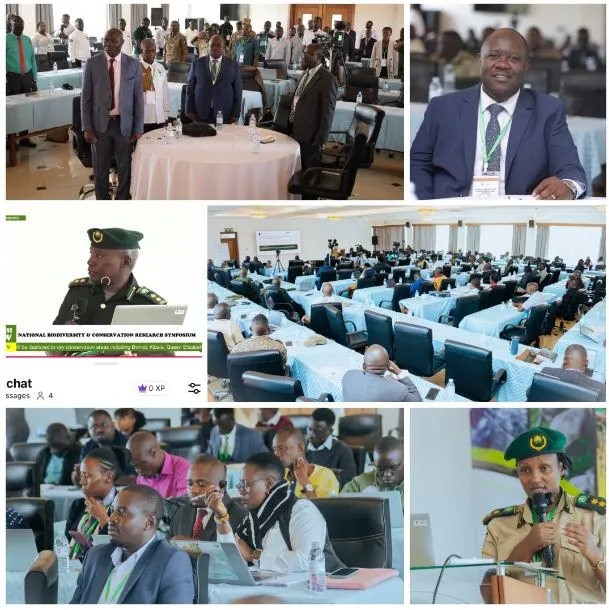
Mukono:For years, wildlife researchers and policymakers responsible for protecting Uganda’s natural heritage have often operated separately, with scientists generating research findings while conservation managers developed policies and interventions with limited engagement between the two.
That long-standing disconnect is now being addressed through the inaugural National Biodiversity and Conservation Research Symposium, a three-day gathering jointly organised by the Uganda Wildlife Authority (UWA) and the Uganda Wildlife Research and Training College (UWRTC).
Held at Kampala Nile Resort in Namanve, Mukono District, from June 22 to 24 under the theme “Biodiversity Under Threat: Science, Innovation and Collaborative Responses,” the symposium has brought together conservation scientists, ecologists, policymakers, development partners, government agencies, students and wildlife practitioners to explore solutions to the growing threats facing Uganda’s biodiversity.
Opening the symposium, UWA Executive Director Dr James Musinguzi stressed the need for science-driven conservation efforts, warning that biodiversity is facing mounting threats that require evidence-based interventions.
“There are many threats afflicting our biodiversity and our wildlife. These threats and gaps must be closed by using empirical data and evidence picked from research, not assumptions, not politics. Science,” Dr Musinguzi told delegates.
Uganda hosts some of Africa’s richest biodiversity, including more than half of the world’s remaining mountain gorillas, over 1,000 bird species and diverse ecosystems ranging from tropical forests and wetlands to savannah grasslands. However, experts warn that climate change, habitat loss, invasive species, illegal wildlife trade, pollution and unsustainable human activities are placing increasing pressure on these resources.
UWRTC Principal Robert Baluku said Uganda’s biodiversity is increasingly threatened by climate change, habitat degradation, invasive species, illegal resource extraction, human-wildlife conflict and changing land-use patterns.
“These pressures threaten not only wildlife and ecosystems but also the livelihoods of millions of Ugandans who depend on natural resources. Addressing them requires more than awareness; it requires evidence-based innovation and collective action,” Mr Baluku said.
Participants noted that although conservation research has expanded significantly in recent years, many institutions continue to operate independently, limiting opportunities for collaboration and knowledge sharing.
Dr Musinguzi identified institutional fragmentation as one of the major barriers to effective conservation, saying agencies involved in research, tourism, conservation and environmental management often pursue similar goals but rarely coordinate their efforts.
Mr Baluku echoed the concern, noting that duplication of research activities and limited dissemination of findings have slowed progress in tackling biodiversity challenges.
To address these gaps, the symposium has prioritised collaboration and knowledge-sharing platforms aimed at bringing together researchers, policymakers and conservation practitioners.
“We need to work in a coordinated manner as government institutions so that we can use little resources to produce a huge impact. This symposium is proof that collaboration and partnership can yield much greater results,” Dr Musinguzi said.
As part of efforts to strengthen conservation knowledge management, UWA announced plans to establish a peer-reviewed research journal and a digital biodiversity repository that will serve as a national database for conservation information and scientific findings.
UWRTC also revealed plans to establish a Uganda Wildlife Research Journal and a Research Ethics Committee to strengthen scientific standards and oversight of wildlife research.
According to Mr Baluku, the initiatives are intended to enhance Uganda’s capacity to generate, manage and utilise locally produced scientific knowledge for wildlife conservation and policy development.
The symposium further highlighted UWRTC’s growing role in wildlife research and training. Earlier this year, the institution was elevated from the Uganda Wildlife Research and Training Institute to a fully-fledged wildlife college under the TVET Act, 2025.
Mr Baluku said the transition positions the institution as a centre of excellence for applied wildlife conservation research focused on addressing real-world challenges facing wildlife and surrounding communities.
The college’s work aligns with the Fourth National Development Plan (NDP IV), which identifies research, science, technology and innovation as key drivers of environmental sustainability, climate resilience and ecosystem restoration.
Beyond conservation outcomes, officials said scientific research also presents economic opportunities for Uganda through partnerships with universities and international institutions.
Such collaborations are expected to attract researchers and students interested in studying Uganda’s unique biodiversity, generating revenue through research permits, field access fees and conservation-related investments.
“We are going to generate funds from research. We are setting up a depository of knowledge, and that knowledge has value,” Dr Musinguzi said.
As discussions continue, delegates expressed optimism that stronger collaboration between researchers, policymakers, conservation agencies and local communities will contribute to a more coordinated and evidence-driven approach to protecting Uganda’s biodiversity.