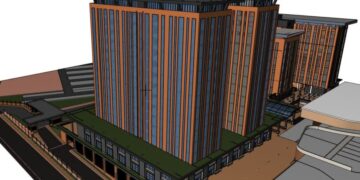















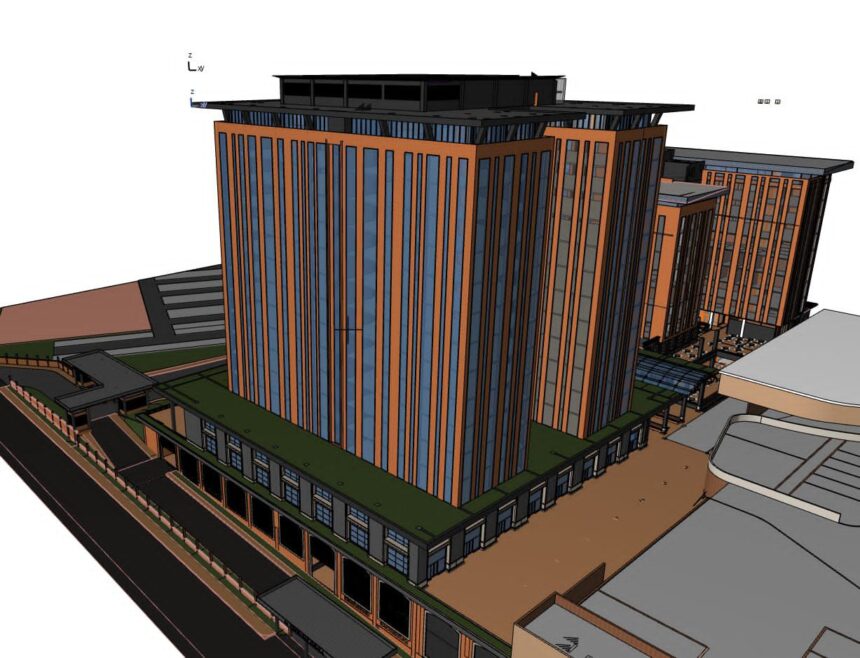
KAMPALA — Kampala’s rapidly changing skyline is set to gain another landmark as the Ruparelia Group advances plans for Kingdom Kampala Phase Two, a major mixed-use development featuring a 21-storey glass tower.
The project, planned adjacent to the existing Kingdom Kampala complex, is expected to expand the development’s commercial, hospitality and residential offerings while reinforcing Kampala’s growing profile as a regional business and investment destination.
Kingdom Kampala has established itself as a major commercial and lifestyle centre in the capital, attracting businesses, shoppers, professionals, diners and visitors.
The planned second phase seeks to build on that development by creating an integrated destination where offices, hospitality, retail and residential facilities operate within one complex.
Integrated commercial and hospitality facilities
The proposed 21-storey tower will feature premium Grade-A office space alongside a luxury hotel with approximately 200 rooms and suites.
The development will also include serviced apartments, penthouses and additional retail outlets designed to complement the existing shopping mall.
The integrated concept is intended to allow business executives, residents and visitors to work, stay, shop, dine and access leisure facilities within the same environment.
One of the project’s notable features will be a rooftop helipad, which is expected to provide an additional transport option for corporate executives, investors and other high-profile visitors.
The development will also incorporate conference and executive meeting facilities, positioning it to host regional and international business events, investment forums and conferences.
Hospitality facilities are expected to include executive lounges, restaurants and other premium guest services.
Focus on urban lifestyle
Beyond commercial and hospitality facilities, the project places emphasis on public spaces and the integration of green areas into the development.
Plans include landscaped rooftop gardens, green terraces and open podium spaces, alongside pedestrian-friendly walkways intended to improve movement and interaction within the complex.
The approach reflects a growing trend in major African cities towards mixed-use developments that combine commercial, residential, hospitality and recreational facilities.
Rather than operating solely as an office complex, Kingdom Kampala Phase Two is intended to provide an integrated urban environment where different activities can take place within one destination.
Expected economic impact
The development is also expected to contribute to employment creation and investment in Kampala’s Central Business District.
Hundreds of jobs are anticipated during the construction phase and after the project becomes operational, while the additional office, retail, accommodation and conference facilities could attract new businesses and visitors to the city.
The project comes as demand for modern commercial office space and high-end hospitality facilities continues to grow in Kampala.
Its proponents say the development will contribute to the capital’s efforts to position itself as a competitive destination for regional business, investment and conferences.
Expanding Kampala’s skyline
Kingdom Kampala Phase Two forms part of the wider transformation of Kampala’s urban landscape, where new commercial and mixed-use developments are increasingly changing the character of the city centre.
The development is expected to combine modern architecture with accessibility, hospitality and commercial functionality, reflecting the changing needs of businesses and urban residents.
For businessman Dr Sudhir Ruparelia, the project represents another major investment in Kampala’s commercial real estate sector.
For the city, the development is expected to add further Grade-A office and hospitality capacity while contributing to the evolution of the capital’s skyline.
When completed, Kingdom Kampala Phase Two will stand alongside the existing complex as a major mixed-use development, combining business, hospitality, retail and residential facilities in a single destination.
The project is therefore expected to become another significant feature of Kampala’s continuing transformation as Uganda seeks to strengthen its position as a regional centre for business, tourism and investment