














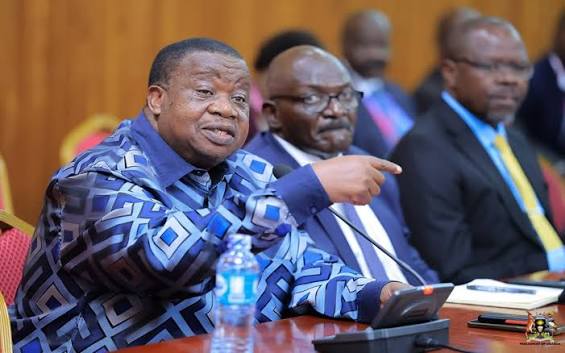
Water and Environment Minister Kahinda Otafiire has told Parliament that he raised concerns about the feasibility of Uganda’s Intelligent Transport Monitoring System (ITMS) project before its implementation, questioning the technology’s compatibility with existing police infrastructure and the exclusion of key security agencies from negotiations.
Appearing before Parliament’s Committee on Physical Infrastructure, Maj Gen Otafiire said his reservations began after security officers returned from preliminary site visits and confirmed that they had not participated in negotiating the project agreement.
“When they came back, I asked them whether they had been involved in the negotiations. They were negative. They said no, they want to be involved in the negotiations,” Otafiire told the committee.
He was serving as Internal Affairs minister when the project was first proposed.
Otafiire said he questioned whether the technology being supplied from Russia would work with Uganda’s existing surveillance infrastructure, which he described as relying on Chinese technology.
“Then I resisted because I said what is coming from Russia does not necessarily match with what we have on the ground, because the technology we have is Chinese. The cameras we have are Chinese technology and they may not be compatible,” he said.
Questions over technology and manufacturing
The minister also questioned claims about the origin and production of the equipment, raising concerns about whether it was being manufactured locally or merely assembled.
He cited geopolitical tensions involving Russia and Poland, alongside sanctions linked to the war in Ukraine, as reasons he doubted the contractor’s account of the equipment’s origin and production arrangements.
“What immediately crossed my mind was this is impossible. Because Poland is at war with Russia, that war with Ukraine, under sanctions, there is no way a Russian company can operate in Poland. Two, they told me the equipment they were bringing was being assembled. There was no manufacturing,” he said.
To establish whether the proposed system was technically viable, Otafiire said he sought independent views from Makerere University, the police and counterparts in Kenya.
He told MPs that the feedback reinforced his concerns, adding that his Kenyan counterparts had reported difficulties with a similar system.
“And I engaged Makerere University, I engaged some other people who know, I engaged the Police. I said, do you think this thing is feasible? They said no, it can’t work. I engaged Makerere University, they told me the same. I engaged my colleagues in Kenya, they also said they had tried and it had failed,” Otafiire said.
Police assessment raises further concerns
Despite his objections, the project proceeded to implementation. Otafiire told the committee that subsequent police assessments raised questions about whether the installed technology could deliver the advanced transport-monitoring capabilities promised by the contractor.
According to his testimony, police found that the system functioned largely as a fleet-management platform, relying on vehicle trackers rather than providing the broader capabilities associated with an intelligent transport-monitoring system.
“Now when it was finally installed, what the Police discovered was that the so-called Intelligent Transport System was what we call fleet management,” he said.
Otafiire further claimed that police considered commercial tracking technology, including systems used by Uber, more advanced than what had been installed under the project.
He also raised concerns about the practical effectiveness of the trackers, claiming that some were reportedly removed from vehicles.
The claims place the system’s technical performance and value for money at the centre of the parliamentary inquiry.
Parliament examines the project
The committee is examining the ITMS project amid questions about its procurement, financial arrangements, technology specifications, manufacturing commitments and implementation.
Otafiire’s testimony raises questions about how concerns reportedly identified before implementation were handled, why key security agencies were not involved in the initial negotiations and whether adequate technical assessments were conducted before public resources were committed.
The inquiry is expected to help lawmakers establish whether the system delivered the capabilities intended by the government and whether the procurement and implementation processes met the required standards.
The minister’s account represents his testimony before the committee; the claims about technical performance, compatibility and manufacturing arrangements require consideration alongside evidence from the contractor, relevant government agencies and other parties involved in the project.