












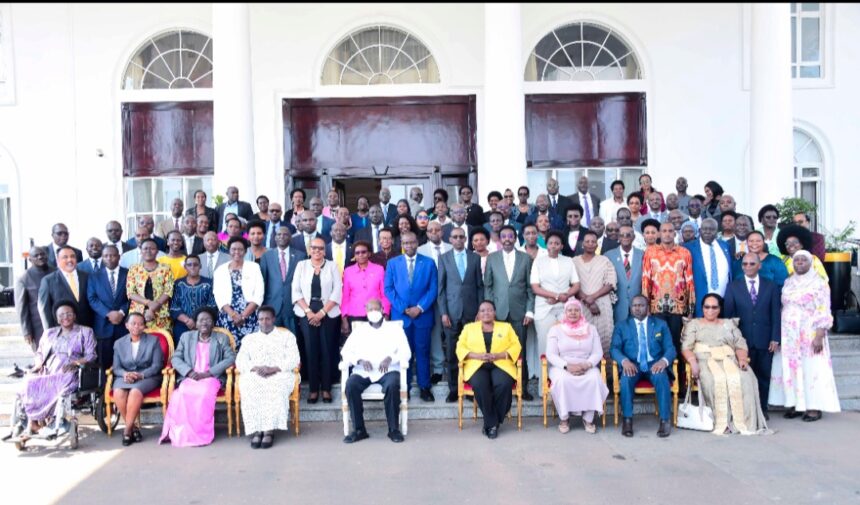
Kampala — President Yoweri Museveni on Monday chaired the first Cabinet meeting of his newly constituted government, formally launching the business of the Executive under the 2026–2031 administration.
The meeting came weeks after the President and his ministers were sworn into office and followed a 10-day Cabinet induction retreat at the National Leadership Institute (NALI) in Kyankwanzi, where ministers were oriented on government priorities, public service values and the implementation of the National Resistance Movement (NRM) manifesto.
The inaugural Cabinet session was attended by Vice President Jessica Alupo, Prime Minister Robinah Nabbanja, deputy prime ministers, Cabinet ministers, ministers of state and senior government officials.
Also present were NRM Secretary General Richard Todwong, permanent secretaries from various ministries, Kampala Capital City Authority Executive Director Hajjat Sharifa Buzeki, and Senior Presidential Advisor on Defence Issues Lt. Gen. Proscovia Nalweyiso.
The meeting marked the formal commencement of collective Cabinet business under President Museveni’s new administration, which is expected to oversee the implementation of government programmes and policy commitments over the next five years.
The Cabinet retreat, which preceded the meeting, was officially opened by President Museveni on June 15 at NALI, Kyankwanzi. It was aimed at equipping both newly appointed and returning ministers with an understanding of government priorities, leadership principles, public service ethics and the strategic direction of the administration for the 2026–2031 term.
According to government officials, the retreat also enabled ministers to align their work plans with the NRM’s development agenda ahead of the commencement of full Cabinet business.
Uganda’s Cabinet derives its mandate from Article 111 of the Constitution, which provides that it shall consist of the President, the Vice President, the Prime Minister and such number of ministers as the President considers necessary for the efficient running of the State.
The current Cabinet comprises 83 members, including Cabinet ministers and ministers of state, who are collectively responsible for formulating government policy and overseeing the implementation of programmes approved by Cabinet.
The first meeting is expected to set the pace for government business as ministries begin implementing priorities outlined for the new administration during the 2026–2031 term.