












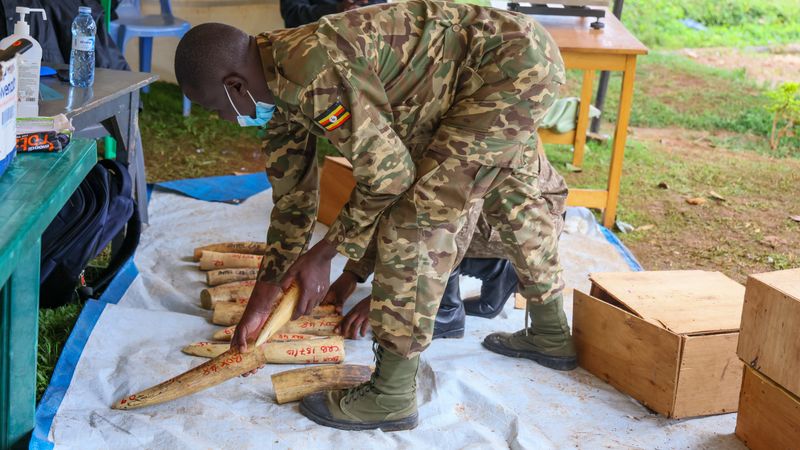
The Uganda Wildlife Authority (UWA) has begun taking custody of one of the largest wildlife contraband stockpiles ever seized in Uganda, a move that underscores the country’s growing determination to dismantle illegal wildlife trafficking networks and protect endangered species.
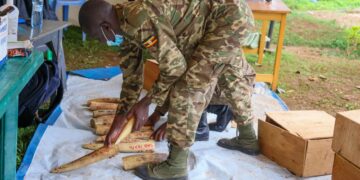
The massive cache, confiscated at Entebbe International Airport between 2012 and 2018, includes thousands of kilograms of ivory, pangolin scales, rhino horns, and other wildlife products that were intercepted during a series of joint enforcement operations targeting transnational trafficking syndicates.
According to UWA, the contraband has been stored at the Aviation Police Station in Entebbe for several years and is now being transferred to the wildlife authority for enhanced management, documentation, and security.
The exhibits comprise 6,017 kilograms of ivory, including both raw and worked pieces, approximately 2,030 kilograms of pangolin scales, 114 kilograms of rhino horns, 8.8 kilograms of hippopotamus teeth, as well as assorted wildlife products such as animal skins and lion teeth.
The illegal wildlife products were seized through coordinated operations conducted by UWA and security agencies at Entebbe International Airport over a six-year period. Investigations revealed that Uganda had been used as a transit route by international wildlife trafficking syndicates moving illegal wildlife products to foreign markets.
In one notable case, traffickers attempted to conceal ivory inside tins labelled as shea butter in a bid to evade detection by law enforcement officers.
The handover exercise officially commenced on May 19, 2026, under the supervision of UWA Assistant Commissioner for Law Enforcement, Margret Kasumba.
Speaking on the significance of the transfer, UWA spokesperson Bashir Hangi said the exercise is crucial for accountability, conservation, and strengthening wildlife crime management systems.
“These exhibits are critical pieces of evidence of the devastating impact that wildlife crime continues to have on endangered species. Taking custody of them allows UWA to strengthen documentation, security and management of these exhibits while reinforcing Uganda’s commitment to combating wildlife trafficking,” Hangi said.
He noted that the recovered products represent the loss of countless animals across Africa and serve as a stark reminder of the urgent need for continued vigilance against wildlife crime.
“Every kilogram of ivory, pangolin scales or rhino horn tells a story of wildlife that was illegally taken from its natural habitat. Our message is clear: Uganda remains committed to protecting wildlife and ensuring that traffickers do not find safe passage through our borders,” he added.
The decision by Aviation Police Entebbe to transfer the exhibits followed increasing pressure on storage space at the station, where the contraband had remained since the seizures were made.
Hangi emphasized that the successful interception of the wildlife products demonstrates the effectiveness of collaboration among various security and enforcement agencies.
“The success registered over the years is a result of strong partnerships between UWA, the Police, Customs, Aviation Security and other stakeholders. Wildlife crime is transnational in nature and requires a coordinated response,” he said.
Authorities also credited strengthened security measures at Entebbe International Airport for the sharp decline in wildlife trafficking incidents recorded in recent years.
Since the deployment of a canine detection unit at the airport in 2018, no wildlife contraband seizure of comparable magnitude has been recorded.
“The canine unit has been a game changer in wildlife law enforcement at the airport. Together with improved surveillance and intelligence-led operations, it has helped deter traffickers and strengthened our ability to detect illegal wildlife products,” Hangi explained.
Conservation experts say the seized ivory, pangolin scales, and rhino horns represent thousands of animals that were killed or exploited to meet demand in illegal international markets. Despite intensified enforcement efforts across the continent, wildlife trafficking remains one of the greatest threats to endangered species.
UWA says the transfer operation is still ongoing, with officials carefully inventorying, documenting, and securing every exhibit under strict conditions.
As Uganda continues to strengthen wildlife protection and law enforcement efforts, authorities hope the handover will stand as a powerful symbol of the country’s commitment to conserving biodiversity and supporting global efforts to eradicate illegal wildlife trafficking.