
















KAMPALA — Nearly a decade after DFCU Bank took over selected assets and liabilities of Crane Bank, the transaction is facing renewed scrutiny as the parties prepare for a substantive hearing before the English High Court.
The dispute, which has its roots in the 2016 collapse of Crane Bank, has evolved from a disagreement over the legality of the takeover into a potentially costly legal battle for DFCU, with the former Crane Bank shareholders seeking damages reportedly exceeding £170 million (about Shs840 billion).
At the heart of the case is a fundamental question: what exactly did DFCU acquire from Crane Bank, what was the value of the transferred business and what were the circumstances under which the transaction was completed?
The answers could have significant financial implications for the parties involved.
From takeover to legal dispute
Crane Bank was placed under statutory management by the Bank of Uganda in 2016 after the central bank declared the lender insolvent.
The bank, which had grown rapidly under businessman Dr Sudhir Ruparelia, was subsequently taken over by the regulator.
In January 2017, DFCU announced that it had entered into an agreement with the Bank of Uganda to acquire selected assets and liabilities of Crane Bank.
The transaction enabled DFCU to expand its branch network and customer base and significantly increased its presence in Uganda’s banking sector.
For DFCU, the acquisition presented an opportunity to emerge as a larger institution with a broader customer franchise and expanded commercial reach.
However, the former shareholders of Crane Bank have challenged aspects of the takeover and the manner in which the bank’s assets and liabilities were transferred.
They dispute the circumstances surrounding the declaration of insolvency and have pursued claims against DFCU and other parties.
DFCU has denied the allegations and continues to defend the proceedings.
Why customer numbers matter
One of the important features of any banking acquisition is the value of the customer franchise.
Customers represent more than account holders. They provide deposits, potential borrowers and a market for payments, digital banking, insurance and other financial services.
The size and quality of a customer base can therefore influence how investors and the market assess the strength of a financial institution.
Following the Crane Bank transaction, DFCU highlighted the expansion of its operations and customer base as evidence of its increased scale.
Nearly 10 years later, those representations could assume a different significance in the ongoing dispute.
The legal question is not simply how many customers were associated with Crane Bank. It is whether the business transferred to DFCU delivered the economic value that the parties or subsequent public representations suggested.
If different figures were used at different stages of the transaction or in subsequent corporate communications, the parties could face questions about what those figures represented and how they relate to the value of the acquired business.
However, whether any particular representation was inaccurate, misleading or legally significant remains a matter for determination through the court process.
Financial cost for DFCU
The legal dispute has already begun to affect DFCU’s financial position.
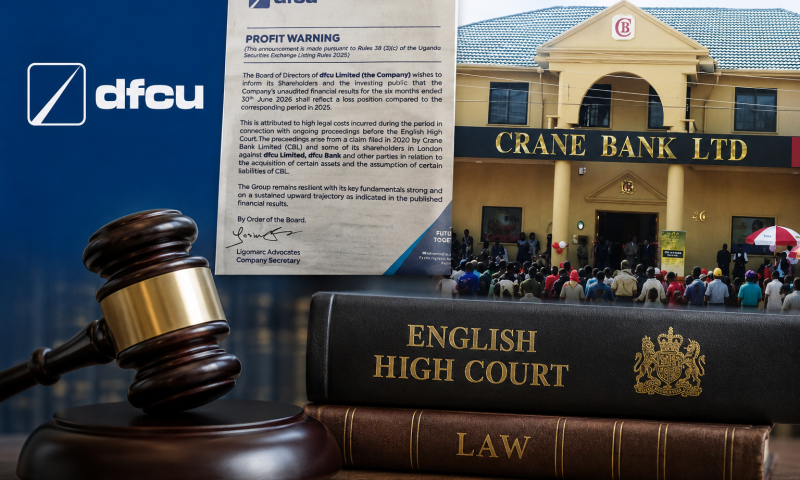
In a July 30, 2026 disclosure to the Uganda Securities Exchange, the bank warned that its unaudited financial results for the six months ended June 30 were expected to show a loss compared with the corresponding period last year.
DFCU attributed the anticipated deterioration principally to substantial legal expenses arising from the English High Court proceedings.
The bank indicated that the expected loss should not necessarily be interpreted as a reflection of weakness in its underlying banking operations.
Nevertheless, the disclosure highlights the financial consequences of a dispute that has remained unresolved for years.
The costs are being incurred as DFCU prepares to defend a transaction that significantly expanded its business in 2017.
Case returns to London
The legal battle has already passed through several stages in the English courts.
In 2022, the English High Court dismissed the claim on jurisdictional grounds.
The case was subsequently revived after the English Court of Appeal ruled in July 2023 that the proceedings could continue.
The substantive trial is scheduled to begin in London in October 2026 and is expected to run for about three months.
The proceedings are expected to examine the circumstances surrounding the takeover, the transfer of Crane Bank’s selected assets and liabilities and claims relating to losses allegedly suffered by the former shareholders.
The court will ultimately determine the issues placed before it based on the evidence and applicable law.
A transaction with lasting consequences
The Crane Bank acquisition was one of the most consequential transactions in Uganda’s banking sector in the past decade.
For DFCU, it provided an opportunity to rapidly expand its physical presence, customer base and market position.
For Crane Bank’s former owners, however, the takeover has remained the subject of a prolonged legal challenge.
The disagreement now comes at a time when DFCU is facing a direct financial burden from the litigation.
The bank’s July disclosure has therefore added a new dimension to a dispute that began with the 2016 intervention by the central bank.
The significance of customer numbers and other indicators of Crane Bank’s business will ultimately depend on how they are presented in the evidence before the court and how the court assesses their relevance to the claims.
What is at stake?
The forthcoming trial could provide greater clarity on several contested issues surrounding the Crane Bank takeover.
Among them will be questions concerning the circumstances that led to the bank being placed under statutory management, the transfer of selected assets and liabilities to DFCU, the value of the business transferred and the alleged losses claimed by the former shareholders.
The reported £170 million-plus claim means the financial stakes are substantial.
For DFCU, the immediate challenge is to defend the claims while managing the legal expenses associated with the proceedings.
For the former Crane Bank shareholders, the London case represents another stage in their long-running effort to challenge the circumstances surrounding the loss of their banking business.
As the October trial approaches, the focus will shift from competing narratives about the 2017 transaction to evidence presented before the English High Court.
Whatever the eventual outcome, the case is likely to remain an important test of the legal and financial consequences of one of Uganda’s most closely watched banking transactions.