






KAMPALA — A prosecution challenge over the professional credentials of a defence witness has opened a fresh legal contest in the case against nine youths accused of trespassing at Pastor Robert Kayanja’s Rubaga Miracle Cathedral.
The State has asked Mwanga II Court to first establish whether Dr Bwambale Fehehansi is legally qualified to testify as a medical expert before he proceeds with evidence concerning examinations he conducted on some of the accused.
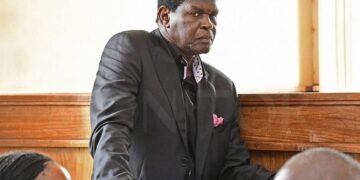
Bwambale, 44, a senior police officer based in Kabalye, Masindi District, appeared in court as Defence Witness Number 10.
He told court that he is a pathologist with a Master of Medicine in Pathology and holds a Bachelor of Dental Surgery from Makerere University.
He said his professional responsibilities include diagnosing diseases, examining living and deceased persons, advising doctors treating patients and providing expert evidence in court.
His appearance became contentious, however, after the defence sought to rely on his findings from examinations of some of the accused who reportedly alleged that they had been sexually abused.
The witness is also said to have completed and signed Police Form 3A relating to the examinations.
Prosecution raises legal objection
Chief State Attorney Jonathan Muwaganya objected to the witness being immediately treated as an expert, arguing that court must first determine the professional capacity in which Bwambale was appearing.
The prosecutor questioned whether the witness was being presented as a medical doctor, pathologist or clinical officer, saying the distinction was important in determining the scope of his professional authority.
The State also placed Bwambale’s professional licences under scrutiny.
According to the prosecution, the witness presented a licence issued by the Uganda Medical and Dental Practitioners Council on March 19, 2026, as well as another document indicating registration under the Allied Health Professionals Council.
Mr Muwaganya argued that the Allied Health Professionals Council regulates allied health practitioners and does not regulate medical officers.
The prosecution further pointed to Bwambale’s Bachelor of Dental Surgery as his foundational professional qualification.
Its argument was that acquiring postgraduate training in pathology does not, by itself, alter the professional category under which a practitioner is registered or expand the legal scope of practice attached to the original qualification.
Scope of examination questioned
The State’s objection became particularly significant because Bwambale is expected to give evidence relating to examinations involving allegations of sexual abuse.
Mr Muwaganya argued that a dentist’s professional scope is principally concerned with dental practice, including conditions affecting the teeth, jaws and oral cavity.
He submitted that while such expertise could extend to certain injuries involving the face, mouth and jaws, it could not automatically qualify the witness to conduct examinations of private parts in sexual and gender-based violence cases.
The prosecution also questioned the circumstances under which Bwambale completed Police Form 3A, after he told court that he carried out the examinations in the capacity of a medical officer of special grade.
The State said records from the dental practitioners’ portal showed that Bwambale was registered as a dentist after obtaining his Bachelor of Dental Surgery in 2014.
It therefore asked court to examine his academic and professional records before accepting him as an expert witness.
Defence challenges objection
The defence lawyers opposed the prosecution’s challenge, arguing that the State had itself disclosed the Police Form 3A documents that were later signed by Bwambale.
They told court that the forms formed part of the prosecution’s disclosure material and that the defence relied on those documents when deciding to call the witness.
The defence position effectively placed the dispute beyond the witness’s academic qualifications and into the question of whether his professional credentials and previous involvement in the examinations should prevent him from giving evidence for the accused.
Court orders verification of qualifications
Presiding Grade One Magistrate Adams Byarugaba directed Bwambale to return with his academic documents and other relevant qualifications for verification.
The order means the court will first determine the witness’s professional standing before deciding the extent to which he can provide expert evidence in the proceedings.
The ruling on his competence could have implications for the weight and admissibility of evidence arising from the medical examinations of the accused.
For now, the courtroom battle has shifted from the allegations against the nine youths to a preliminary but potentially important question: what professional authority did the witness possess when he examined the accused and prepared the medical documentation being relied upon in court?
The case will resume with the court expected to scrutinise Bwambale’s academic qualifications, professional registration and licences before determining whether he can proceed with his expert testimony.