









By Infora Media
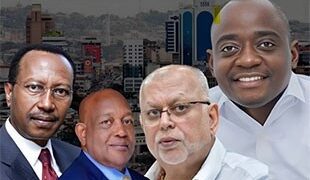
Fourteen of Uganda’s wealthiest business magnates control assets equivalent to nearly one-sixth of the country’s annual economic output, according to the Uganda Wealth Power Index 2026, a private wealth assessment that is likely to reignite debate over inequality and market concentration in one of East Africa’s fastest-growing economies.
The index estimates that the combined net worth of the 14 tycoons stands at approximately $10.3 billion, roughly 15.9 percent of Uganda’s Gross Domestic Product (GDP), which stood at about $65 billion in 2025, based on data from the Uganda Bureau of Statistics and international financial institutions.
While Uganda has maintained steady growth projections of between 6 and 7 percent in the 2025/26 financial year, according to government estimates and recent assessments by the International Monetary Fund, the concentration of wealth among a small elite highlights persistent structural imbalances in asset ownership.
The index shows that real estate remains the single largest driver of private wealth accumulation, particularly in Kampala’s high-value commercial districts.

Among those ranked highly is businessman Hamis Kiggundu, whose investments in commercial property and agro-processing have expanded rapidly over the past decade. Also prominently featured is Sudhir Ruparelia, chairman of the Ruparelia Group whose interests span banking, education, hospitality and real estate.
Other notable property investors cited include Drake Lubega and John Bosco Muwonge, whose commercial holdings have shaped large sections of Kampala’s skyline.
Beyond property, wealth accumulation among the top tier is linked to manufacturing, telecommunications, financial services, agriculture value chains and energy, sectors that have benefited from urbanisation, infrastructure expansion and regional trade integration.
Uganda’s economy has posted consistent recovery following pandemic-related slowdowns, with infrastructure spending, oil-sector development and private investment driving output. However, analysts caution that GDP growth does not automatically translate into widespread asset ownership.
Data from the World Bank shows that a significant portion of Uganda’s workforce remains engaged in subsistence agriculture and informal employment, where incomes are typically low and volatile. Small and medium enterprises (SMEs), though contributing substantially to employment, often struggle with limited access to affordable capital.
“The emergence of high-net-worth individuals is a sign of private sector dynamism,” said a Kampala-based economist familiar with wealth distribution trends. “But the deeper issue is how concentrated asset ownership affects competition, access to finance and long-term inclusivity.”
He added that property-led wealth creation tends to favour early entrants with access to capital and land, potentially widening the gap between established investors and new entrepreneurs.
The findings come at a critical moment as Uganda prepares for commercial oil production, expected to significantly expand national revenues and attract foreign direct investment. Major infrastructure projects linked to the oil and gas sector are anticipated to stimulate growth in construction, logistics, financial services and manufacturing.
However, economists warn that without deliberate policy measures — including SME financing frameworks, value-addition incentives and industrial linkages — new wealth could remain concentrated within established networks.
The government’s development blueprints emphasise industrialisation, agro-processing and job creation as pillars for achieving middle-income status. Yet observers argue that inclusive growth will require broader participation in asset ownership beyond large conglomerates.
Wealth concentration trends are not unique to Uganda. Globally, property appreciation and capital market expansion have disproportionately benefited top-tier investors. However, in lower-middle-income economies, the social and political implications of such concentration can be more pronounced.
In Uganda’s case, the Wealth Power Index provides a snapshot of economic influence at a time when the country is undergoing structural transformation.
Whether the coming oil revenues and industrial expansion will diversify wealth ownership, or further entrench it, remains an open question.
For now, the 2026 index underscores a stark reality: a small group of business magnates commands a share of wealth equivalent to nearly one-sixth of Uganda’s annual economic output, reflecting both entrepreneurial success and the enduring challenge of equitable economic participation.